
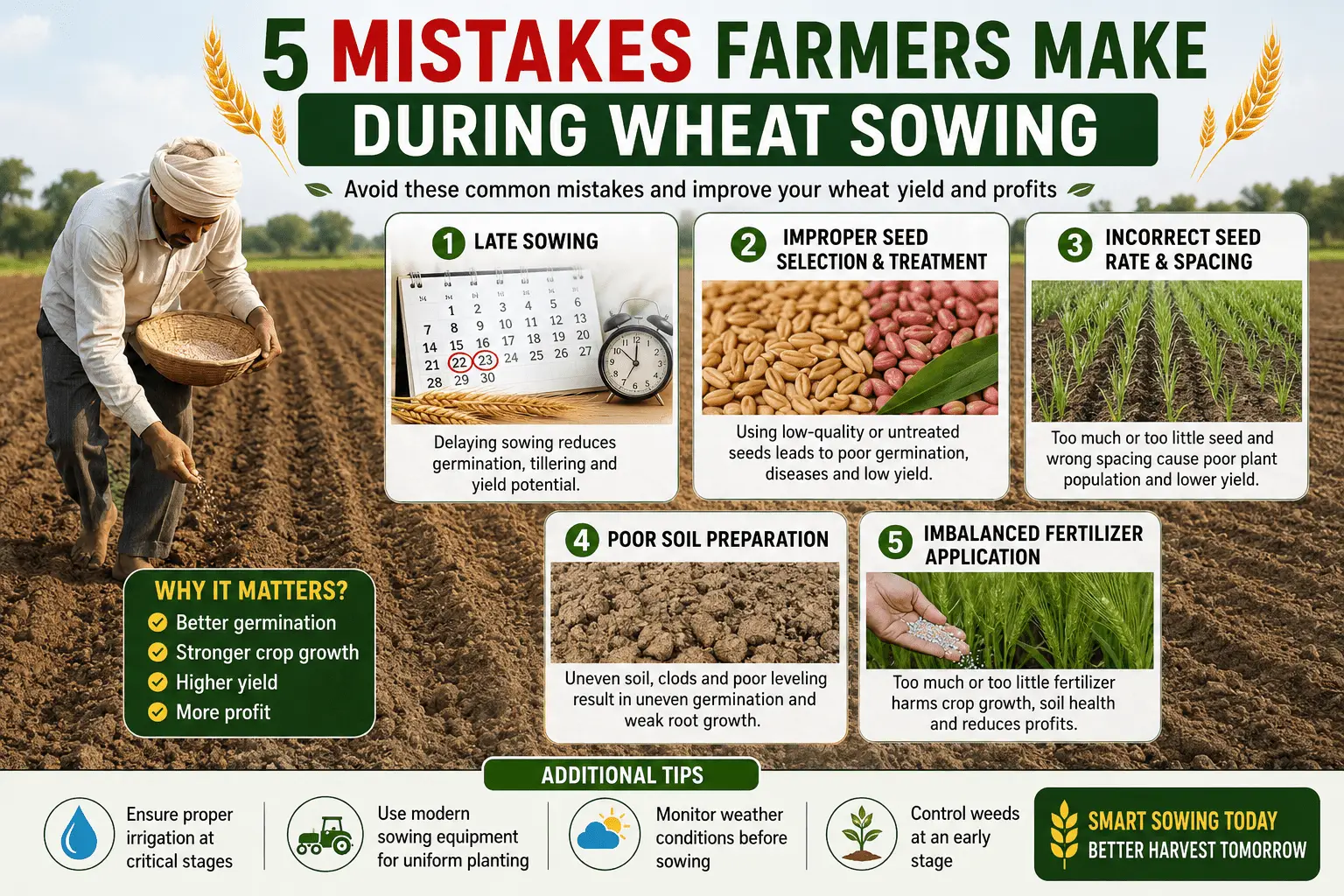
Wheat is a staple crop and a major source of income for millions of farmers. However, achieving a high yield depends heavily on proper sowing practices. Even small errors at the sowing stage can affect the entire crop cycle. Many farmers unknowingly repeat the same errors every season, which leads to reduced productivity and profit.
Understanding the mistakes mistakes farmers make during wheat sowingis the first step toward improving crop performance. When farmers are aware of these mistakes and take preventive measures, they can significantly increase yield and ensure better crop quality. In this article, we will explore the top 5 mistakes farmers make during wheat sowing and practical ways to avoid them.
1. Late Sowing of Wheat
One of the most critical mistakes farmers make during wheat sowing is delaying the sowing time. Wheat is highly sensitive to temperature, and timely sowing ensures proper germination and growth. When sowing is delayed, the crop faces unfavorable weather conditions during its growth stages. Temperature plays a vital role during the early growth period, and even slight deviations can impact plant development.
Late sowing often results in:
Reduced germination rate
Poor tillering
Increased risk of pest and disease attacks
Lower grain filling, leading to reduced yield
In addition to these problems, late-sown crops often experience heat stress during the grain filling stage, which further reduces grain size and weight. The crop may also mature faster than normal, giving less time for proper development. This ultimately affects both the quantity and quality of the harvest. Farmers who delay sowing may also face irrigation challenges, as the crop water requirement shifts to warmer periods.
Farmers who make such mistakes farmers make during wheat sowing often struggle with poor crop performance. Their crops may look uneven, weak, and less productive compared to timely sown fields.
Solution:
Farmers should follow the recommended sowing window for their region. In most parts of North India, wheat sowing is best done between late October and mid-November. Preparing the field in advance and ensuring availability of seeds and inputs can help farmers sow on time. Timely sowing helps the crop utilize favorable weather conditions during all growth stages. Timely sowing helps avoid the common mistakes farmers make during wheat sowing and supports healthy plant growth.
2. Improper Seed Selection and Treatment
Another major mistakes farmers make during wheat sowing is using low-quality or untreated seeds. Seeds are the foundation of the crop, and poor seed quality directly impacts productivity. If the seed itself is weak or infected, the crop will never reach its full potential, no matter how well other practices are followed.
Problems caused by this mistake include:
Uneven germination
Weak seedlings
Higher chances of disease infection
Poor crop stand
Low-quality seeds may carry fungal infections or may not have the genetic potential for high yield. As a result, farmers may see patchy fields where some plants grow well while others fail to emerge properly. This uneven growth creates difficulty in managing irrigation, fertilizers, and weeds.
Many farmers ignore seed treatment, which is one of the hidden mistakes farmers make during wheat sowing. Without treatment, seeds remain vulnerable to soil-borne diseases and pests during the initial growth stages. Early-stage infections can damage roots and reduce plant vigor, leading to long-term yield loss.
Solution:
Always use certified, high-yielding seed varieties recommended for your region. Selecting seeds that are suitable for local climate conditions increases the chances of success. Seed treatment with fungicides or bio-agents helps protect the crop from early-stage diseases. It also improves germination and seedling strength. Proper storage of seeds before sowing is equally important to maintain their quality. Avoiding these mistakes farmers make during wheat sowing ensures uniform growth and a healthy crop.
3. Incorrect Seed Rate and Spacing
Maintaining the correct seed rate and spacing is essential, yet it is one of the frequent mistakes farmers make during wheat sowing. Some farmers use excessive seeds, while others use too little, both of which negatively affect yield. Balanced plant population is necessary for optimal use of nutrients, water, and sunlight.
Effects of incorrect seed rate:
Overcrowding leads to competition for nutrients, water, and sunlight
Poor air circulation increases disease risk
Low seed rate results in inadequate plant population
When seeds are sown too densely, plants compete with each other, leading to weaker growth and thinner stems. This increases the chances of lodging (plants falling over), especially during strong winds or heavy irrigation. On the other hand, using fewer seeds leaves gaps in the field, allowing weeds to grow more easily and reducing overall yield potential.
Such mistakes farmers make during wheat sowing reduce the efficiency of crop growth. Improper spacing also makes it difficult to carry out intercultural operations like weeding and fertilizer application effectively.
Solution:
Follow the recommended seed rate (generally 100–125 kg per hectare) and proper row spacing (around 20–22 cm). Using proper sowing equipment can help maintain uniform spacing across the field. Farmers should also calibrate their seed drills before use to ensure accurate seed distribution. Proper spacing allows plants to grow efficiently by giving each plant enough access to sunlight, nutrients, and moisture. It also improves airflow, reducing the risk of diseases. Proper spacing allows plants to grow efficiently and reduces the chances of mistakes farmers make during wheat sowing
4. Poor Soil Preparation
Ignoring soil preparation is a serious mistakes farmers make during wheat sowing that can limit crop potential. Wheat requires a well-prepared, fine seedbed for proper root development and nutrient uptake. If the soil is not properly prepared, even high-quality seeds and fertilizers cannot deliver good results. Proper soil structure allows roots to penetrate easily and absorb nutrients efficiently.
Consequences of poor soil preparation:
Uneven germination
Weak root system
Poor moisture retention
Difficulty in fertilizer absorption
In addition to these issues, poorly prepared soil may contain clods, weeds, and residues that interfere with seed placement. This leads to inconsistent seed depth, which further causes irregular crop emergence. Soil that is not leveled properly can also result in uneven water distribution during irrigation, leaving some areas dry while others become waterlogged.
Farmers who ignore soil preparation often face reduced plant vigor and lower resistance to environmental stress. These long-term problems are often the result of repeated mistakes farmers make during wheat sowing. When the soil is compact or not properly aerated, roots fail to expand, leading to stunted growth and poor nutrient uptake.
Another important factor is weed control. Without proper land preparation, weeds compete aggressively with wheat plants for nutrients, sunlight, and water. This competition further reduces yield and increases management costs. Such situations clearly show how critical it is to avoid mistakes farmers make during wheat sowing related to soil preparation.
Farmers who overlook soil preparation often face long-term issues due to these mistakes farmers make during wheat sowing. Over time, soil health declines, making it even harder to achieve good yields in future seasons.
Solution:
Proper land preparation includes ploughing, harrowing, and leveling the field. These steps help break soil clods, remove weeds, and create a fine seedbed. A well-prepared field ensures better seed-to-soil contact and improves germination. Farmers should also ensure proper moisture in the soil before sowing, as it plays a key role in seed germination.
Using organic matter like compost or farmyard manure can further improve soil structure and fertility. Laser leveling can also be used for precise land leveling, ensuring uniform irrigation. By taking these steps, farmers can significantly reduce mistakes farmers make during wheat sowing and improve crop performance. By avoiding these mistakes farmers make during wheat sowing, farmers can achieve uniform crop growth.
5. Imbalanced Fertilizer Application
Applying too much or too little fertilizer is another common mistakes farmers make during wheat sowing. Crops need a balanced supply of nutrients for proper growth, and incorrect fertilization can harm both yield and soil health. Fertilizers are essential, but their improper use can lead to more harm than good.
Problems caused by imbalanced fertilizer use:
Nutrient deficiency or toxicity
Weak plant growth
Soil degradation over time
Increased cost without proper results
Excessive use of nitrogen may lead to lush green growth but weak stems, making plants more prone to lodging. On the other hand, deficiency of essential nutrients like phosphorus and potassium can limit root development and reduce grain formation. These imbalances directly impact yield and crop quality.
Many farmers apply fertilizers based on guesswork rather than actual soil needs. This is one of the hidden mistakes farmers make during wheat sowing that increases input costs without improving productivity. Over time, continuous misuse of fertilizers can degrade soil health, reducing its natural fertility.
This is one of the most expensive mistakes farmers make during wheat sowing. Not only does it affect the current crop, but it also creates long-term problems for future cultivation. Imbalanced fertilization also affects microbial activity in the soil, which is essential for maintaining soil fertility.
Solution:
Farmers should conduct soil testing before applying fertilizers to understand nutrient requirements. Based on the results, they should use a balanced mix of nitrogen, phosphorus, and potassium along with organic manure. Integrated nutrient management is the best approach to maintain soil health and improve yield.
Splitting fertilizer application into stages—such as basal dose and top dressing—helps in better nutrient utilization. Using bio-fertilizers can also improve soil fertility naturally. By following these practices, farmers can reduce mistakes farmers make during wheat sowing and ensure efficient use of inputs. Splitting fertilizer application into stages also helps improve efficiency and reduces mistakes farmers make during wheat sowing.
Additional Tips to Avoid Wheat Sowing Mistakes
Apart from the major mistakes farmers make during wheat sowing, there are a few additional practices that can further improve yield and crop health:
- Ensure proper irrigation at critical stages such as germination, tillering, and grain filling
- Use modern sowing equipment for uniform planting and accurate seed placement
- Monitor weather conditions before sowing to avoid unfavorable situations
- Control weeds at an early stage to reduce competition for nutrients
Adopting these best practices helps farmers avoid repeated mistakes farmers make during wheat sowing. Small improvements in management can lead to significant increases in productivity and profitability.
Conclusion
Wheat sowing is a crucial stage that determines the success of the entire crop cycle. The mistakes farmers make during wheat sowing may seem small, but their impact can be significant. From delayed sowing and poor seed selection to improper fertilization and soil preparation, each mistake affects yield and profitability.
Farmers who continuously repeat mistakes farmers make during wheat sowing often struggle to achieve good results despite investing time and resources. However, by understanding the root causes and applying the right techniques, these problems can be avoided.
By understanding and avoiding these mistakes farmers make during wheat sowing, farmers can improve crop health, increase production, and maximize profits. Smart farming practices, proper planning, and timely decision-making can make a big difference in achieving a successful wheat harvest.